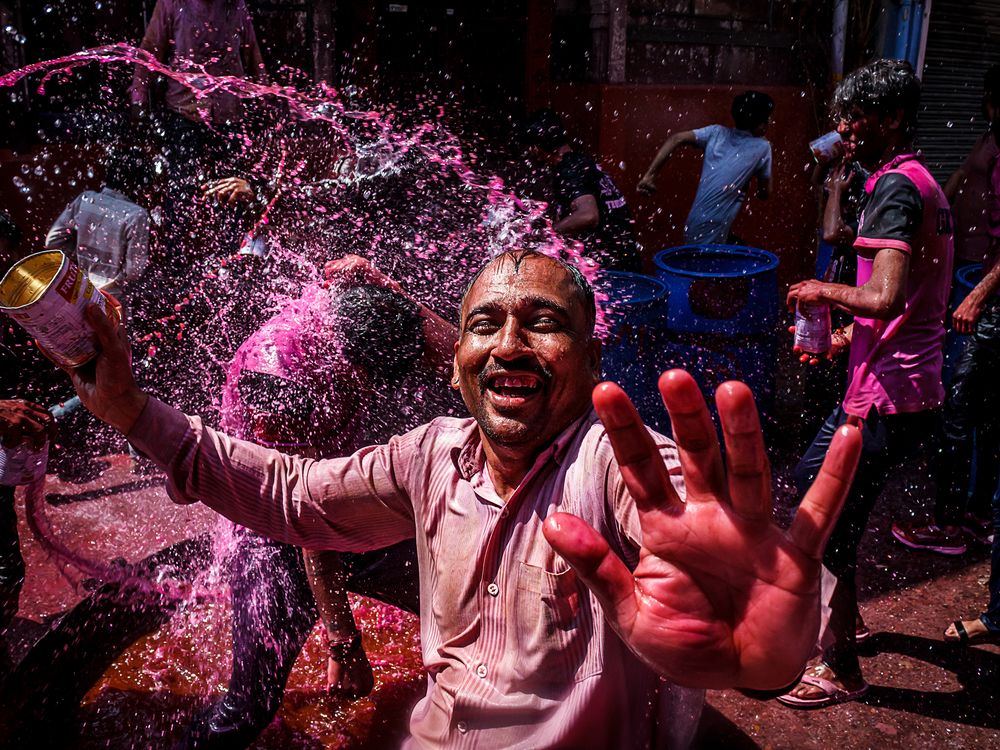
 Holi, known as the **Festival of Colours** (or Rangwali Holi), is a vibrant Hindu celebration that marks the arrival of **spring**, the triumph of **good over evil**, and the joy of **love and renewal**. The playful throwing of coloured powders (called *gulal*) and coloured water is the most iconic part of the festival.
### Main Reasons for Celebrating Holi with Colours
1. **Symbol of Spring and Nature’s Rejuvenation**
Holi falls at the end of winter and the beginning of spring (usually in March, on the full moon of the Hindu month Phalguna). The bright colours represent the blooming flowers, fresh leaves, and vibrant energy of the new season. It is a time to celebrate life’s renewal and say goodbye to the dullness of winter.
2. **Victory of Good over Evil (Holika Dahan Story)**
The core legend comes from Hindu mythology: The demon king Hiranyakashipu wanted everyone to worship him, but his young son Prahlad remained devoted to Lord Vishnu. The king asked his sister Holika (who had a boon to survive fire) to kill Prahlad by sitting with him in a blazing fire. Thanks to Prahlad’s unwavering faith, he survived unharmed while Holika was burned to ashes.
The night before Holi (called **Holika Dahan** or Chhoti Holi), people light bonfires to symbolize the burning away of evil, negativity, ego, hatred, and impurities. The next day, playing with colours celebrates the joy that follows this victory of good (dharma) and devotion.
3. **Celebration of Divine Love (Radha-Krishna Legend)**
In the Braj region (associated with Lord Krishna), Holi is deeply linked to the playful love between **Radha** and **Krishna**. Krishna, who had dark/blue skin, felt self-conscious about his complexion compared to the fair Radha. His mother Yashoda playfully suggested he colour Radha’s face. Krishna did so, and this turned into a fun, loving exchange.
Throwing colours today honours this divine, boundary-less love — it erases differences of colour, caste, gender, status, or background. Everyone becomes equal in the chaos of colours.
4. **Social and Spiritual Unity**
Colours break down social barriers. When people throw *gulal* on each other, rich and poor, young and old, friends and strangers all look the same. It promotes forgiveness, forgetting old grudges, and strengthening community bonds. Spiritually, it represents applying the “colour of love” or devotion, making all differences disappear.
### Symbolic Meanings of the Colours
Each colour used in Holi carries deeper significance:
– **Red** — Love, passion, fertility, and purity.
– **Blue** — Lord Krishna (and the divine).
– **Green** — New beginnings, growth, and the freshness of spring.
– **Yellow** — Prosperity, knowledge, and auspiciousness (often linked to turmeric).
– Other shades represent joy, energy, and the full spectrum of life and emotions.
Traditionally, colours were made from natural ingredients like flowers, turmeric, and herbs (which also had medicinal and cooling benefits for the skin in spring). Today, many use safe, eco-friendly alternatives.
In short, we celebrate Holi with colours to embrace joy, renewal, equality, and the victory of light over darkness — turning a mythological triumph and the beauty of spring into a colourful, inclusive party that everyone can enjoy!
It’s one of the most fun and inclusive festivals, where the mess of colours ultimately brings people closer together.